
One thing I truly cherish is the unexpected delight when one movie ends and another begins, catching you completely off guard. You had no plans to watch it, and it wasn’t even a blip on your radar, yet somehow it captivates you entirely. The opening scenes draw you in with a magnetic pull, and soon you find yourself engrossed, eager to uncover its name and share the discovery with everyone you know. This is precisely how I felt about the 2019 feature, Unknown Visitor.
Art Of Found Footage
Unknown Visitor comfortably nestles within a genre that rarely piques my interest—found footage films. It’s not that I’m entirely opposed to them; in fact, “Paranormal Activity” ranks among my favorites. However, as a whole, I’m not particularly fond of the genre, especially the earlier entries, primarily due to the raw and unpolished quality they often strive to capture in order to maintain a sense of authenticity.
One of the most renowned found footage films is “The Blair Witch Project,” though it wasn’t the first of its kind. Before its release, there was Cannibal Holocaust, which didn’t fare well at the time due to its shockingly realistic portrayal. The film was considered so disturbingly authentic that, as the story goes,
“The director of “Cannibal Holocaust” was arrested on charges of murder, obscenity, and distribution of snuff. The violence and murders depicted were so convincingly lifelike that the actors had to appear on live television to establish the director’s innocence.”
As the years rolled by, audiences became more receptive to such films. Thus, it’s fair to say that “The Blair Witch Project” can be likened to the Helen of Troy of found footage films, the catalyst that launched a thousand similar cinematic endeavors.
The Blair Witch Project: A Genres Helen of Troy
“The Blair Witch Project” revolved around a group of adventurous kids who set out to capture the elusive Blair Witch, a legendary creature, on camera. As Wicked Horror insightfully points out regarding the unique design of this type of film,
“There is no narrator or overarching plot in the traditional sense, but a person or group of people’s account of events once transpired.”
This approach inherently possessed a certain allure, making the audience feel as though they were right there, in the thick of the action. Wicked Horror further describes it as,
“Put them in the headspace of the characters. Destroy their point of view as a viewer only to recreate their perception through the eyes of a victim.”
We were drawn into the swirling maelstrom of terror and anxiety alongside the characters, feeling their fear and uncertainty. However, I found the extreme close-ups of nostrils and eyeballs somewhat jarring, as they tended to pull me out of the immersive experience of the film. Moreover, the constant tremors and shakiness of the camera, intended to add realism, often made the scenes too indistinct, blurring the lines of clarity and leaving me straining to decipher what was unfolding. This lack of visual coherence was detrimental to my enjoyment.
The Omnipresent Eye: Ring Cameras and Rising Dread
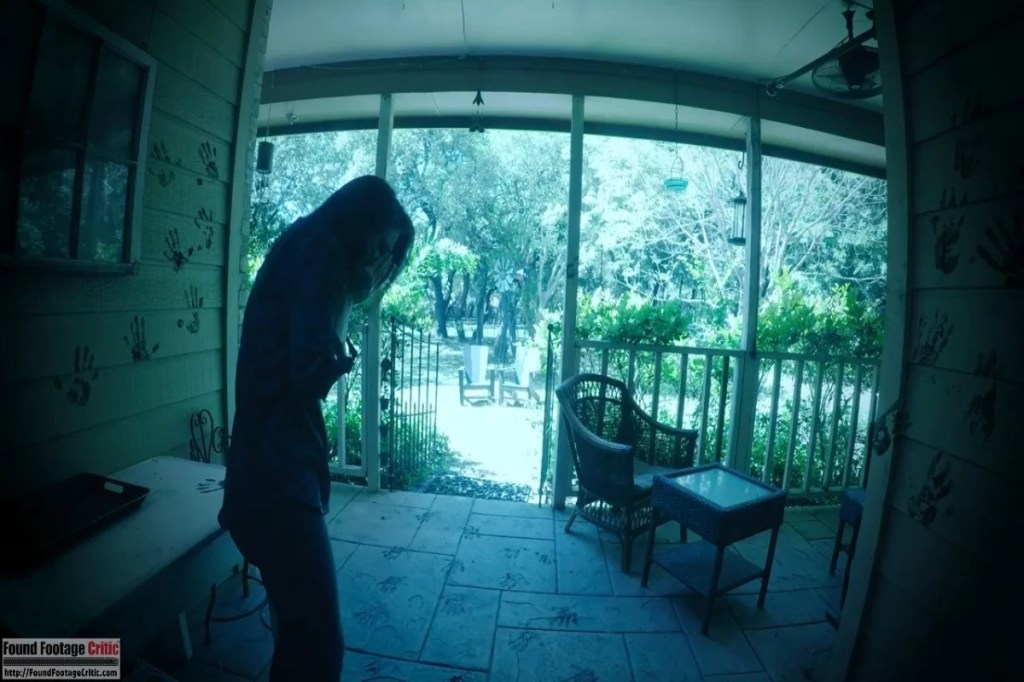
The concept has evolved significantly due to advancements in technology. “Unknown Visitor” is not entirely a novel idea; it has been explored before in shows like “American Horror Stories,” where it made quite an impact. When it appeared on my screen, I wasn’t at all surprised by the gripping allure of this film.
The movie revolves around a couple. All the chilling events unfold through the lens of a ring camera, adding a modern twist to the classic horror tale. The female protagonist is gradually consumed by a growing sense of anxiety and trepidation as she repeatedly encounters mysterious phenomena at her doorstep, much of which she observes through the omnipresent eye of the camera. She calls on her male companion for help. As the narrative unfolds, the occurrences intensify in terror, masterfully heightening audience engagement—a crucial element for any compelling horror film.
Ghostly Glimpses: Terror in the Margins
Interestingly enough, it is the minimal expression of the ghost that renders it truly terrifying. Its fleeting appearances add an extra layer of intensity to the experience. This movie possesses a visceral component that compels you to feel like an active participant in the unfolding drama—a quality I always regard as a positive element. As noted by Stage 32,
“suspense amplifies emotional interest and audience engagement. Suspense is crafted when audiences observe a specific type of conflict-crisis within the story that impacts the lives of fictional characters. This sense of suspense transcends genres, evoking various forms of anxiety and anticipation.”
Shallow Roots, Strong Thrills
The film, while not excessively lengthy, unfolds entirely within a single, central location. Certain aspects of the narrative could be perceived as weak. Notably, the story lacks a crucial element: the “why.” This is an essential aspect of any film. Why is this event unfolding? What exactly set these occurrences into motion? Unfortunately, we are left without a clear understanding of who the characters truly are, which hinders our ability to become deeply invested in their journey.
The conclusion offers a degree of satisfaction, yet it leaves the audience yearning for more. The characters’ reactions are somewhat lacking in depth, and some of the major plot drivers stretch credibility. However, the film is undeniably entertaining, as it successfully captured and held my attention throughout its duration. While it may score lower in terms of structural components, its entertainment and engagement value are undoubtedly present. For those who want something to wet their palate for terror, “Unknown Visitor” is currently streaming on Prime.
 Uncut Diamonds