
Some films have heart, some have bite—and a rare few manage to carry both. The 2025 adaptation of Stephen King’s “The Long Walk” is one of those rare works. It stands out not only as one of the most emotionally soaked, unforgettable films of the year, but as one that lingers far beyond, leaving its mark within the genre itself.
The Path to Production
In the earlier years of his career, King did what many writers before him had done when pushing into riskier territory—he chose to write under a different name. The pseudonym he adopted was the plain and unassuming Richard Bachman, a mask behind which he experimented with stories a divergence from those released under his own name. As the Journal of Computational Literary Studies notes,
“King has published no less than seven novels under the pen name Richard Bachman: Rage (1977), The Long Walk (1979), Roadwork (1981), The Running Man (1982), Thinner (1984), The Regulators (1995), and Blaze (2007).”
Though this dual identity is common knowledge now, it wasn’t always so. For years, the name Richard Bachman carried its own shadow, separate from King’s. That curtain didn’t fall until after the publication of “Thinner,” when the secret finally slipped into the public eye. The revelation added a new layer of intrigue to the already haunting novels—and only deepened the mystique surrounding “The Long Walk.”
King’s Pen Presence
King’s work under the Bachman pseudonym was not widely discussed, nor did it receive much critical attention at the time. As the Journal of Computational Literary Studies notes, his early Bachman novels were rarely reviewed, and comparisons to King’s own style didn’t surface until “Thinner.” That was when a reviewer cautiously remarked that Bachman’s style is remindful of Stephen King,” prompting others to draw similar connections. Why those links weren’t made earlier is less important than what’s now understood: the 2025 feature film “The Long Walk” is based on a Stephen King novel, though originally published under his alias. And from beginning to end, the author’s hallmark presence is undeniable.
Why Character Matters: The Heart of The Long Walk

One of the greatest strengths of “The Long Walk” lies in its character development. This is especially vital for a film that leans so heavily on dialogue. Much of the runtime is carried by the conversations, reflections, and rationalizations of the young men forced into the longest walk of their lives—or, more accurately, their final march. “The Long Walk” is, at its core, a masterclass in emotional bonding. What makes the film so unforgettable isn’t spectacle or grand set pieces—it’s the way it draws the viewer into the inner lives of its characters. By the time the march is underway, you’re not just watching these young men, you’re walking beside them, feeling every fear, every flicker of hope, every quiet moment of resignation.
The Art of Subtlety: Why The Long Walk Lingers in the Mind
What really gives the film its weight is the subtext. The emotions simmer beneath the dialogue, carried in the glances, the silences, and the restrained performances of the cast. This is where the film finds its power. As Linda Seger has described, subtext is
“The true meaning simmering underneath the words and actions,” and here it elevates the entire experience.
The actors don’t just play their roles—they invite you to lean in, to connect, and to care. That’s why the film stays with you long after the credits roll.
A March Into Fear: The Visual and Emotional Power of The Long Walk
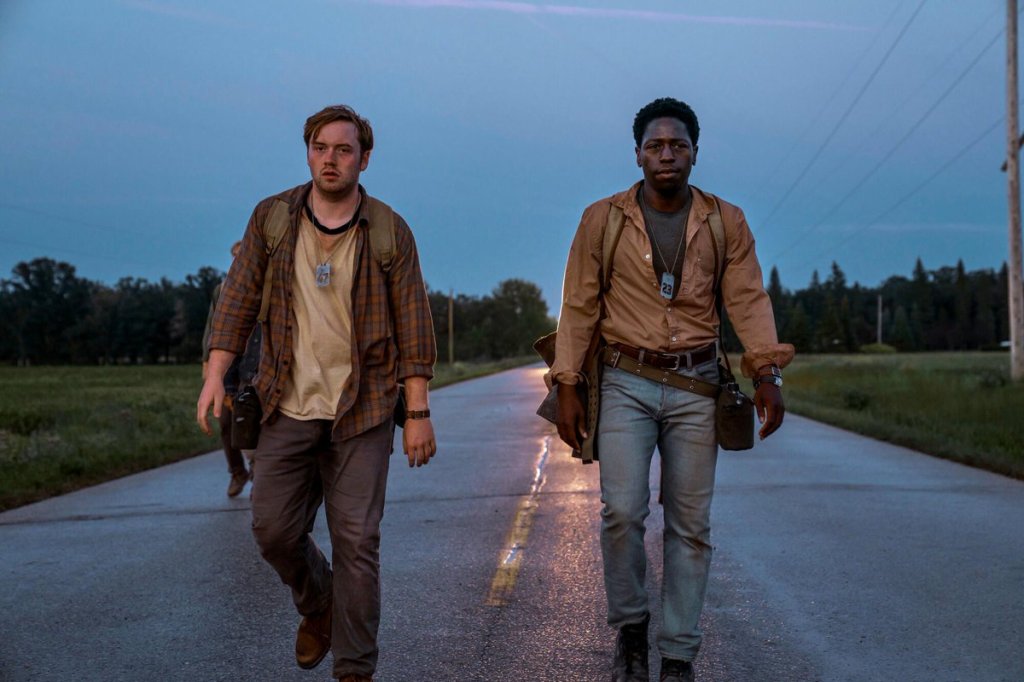
Beyond its expert dialogue, stellar casting, and emotional depth, “The Long Walk” is also a visually striking film. The cinematography captures the boys’ flickers of hope and waves of anguish against the backdrop of a deceptively serene countryside. Passing images of townsfolk—old and young alike—along with fleeting glimpses of horses and weathered structures, ground the story in time and place. Meanwhile, the endless stretches of empty road underscore the isolation of these young men, marching under relentless scrutiny, in brutal conditions, and beneath the watchful eye of an oppressive regime.
This is a film that lingers. It unsettles. It carves its way into your bones with a horror that feels all too real—nightmares born of human cruelty, societal complicity, and warnings we dare not ignore. “The Long Walk” is not just another adaptation—it’s a march straight into the heart of fear, and it refuses to let you go.
 Uncut Diamonds