
This film was introduced to me as one of the standout horror releases of 2025. Claims of that magnitude are typically met with measured skepticism rather than immediate excitement. Still, there is value in examining what broader audiences are embracing as exemplary at any given cultural moment. With that in mind, “Bring Her Back” earned a place on my watchlist, and I finally engaged with it yesterday.
Inflated or Realistic?
The film currently holds a 7.1/10 rating on IMDb—an impressively high mark for a horror title. By the end of its one-hour-and-forty-four-minute runtime, however, that score felt somewhat inflated. While the film sustains a level of intensity consistent with the genre, it ultimately fails to deliver the narrative and structural cohesion necessary to justify such acclaim.
The Importance of Impactful Storytelling
At its foundation, cinema is storytelling, and storytelling is inherently character-driven. Audiences invest when they understand a character’s objective—whether they hope to see it realized or thwarted. The clearer the goal and the stronger the emotional tether, the deeper the engagement. “Bring Her Back” falters in this essential area. The film does not offer a clearly defined protagonist. While it presents several central figures, it never establishes a true narrative anchor.
How “Bring Her Back” Moves Forward
The story initially situates us with Piper, whom we meet before her older brother and guardian, Andy. Yet Piper is never assigned a discernible goal. Andy’s motivation—to protect his sister—emerges more clearly as the film progresses, but even this purpose feels secondary rather than central. Instead, the character with the most clearly articulated objective is the antagonist, Laura. In fact, this is Laura’s story. Her goal drives the plot and, by extension, motivates the actions of the other characters.
Subplot vs. Main Plot
By narrative logic, Andy and Piper’s storyline functions as a secondary thread. As Reedsy defines it,
“A subplot is a secondary storyline that runs alongside the main plot… enhancing the narrative.”
The problem here is that the subplot consumes more narrative real estate than the primary plot itself. The film’s title, “Bring Her Back,” explicitly references Laura’s objective, yet the audience is given minimal insight into her desperation. We are left without a substantive understanding of what propels her actions, how she discovered the means to achieve her goal, or why she believes the method will succeed. Fragmented flashbacks provide suggestion rather than clarity, forcing viewers to infer meaning through interactions between Laura and Oliver, Laura and Andy, and Andy and Oliver—none of which sufficiently illuminate the mechanics or the deep why of the central conflict.
Unsettled, Not Unsettling
By the film’s conclusion, the antagonist fails to achieve her goal, yet this failure is not accompanied by meaningful transformation, reckoning, or resolution. As the film’s primary narrative engine, Laura undergoes no discernible growth, and the story offers no compensatory sense of closure. The ending leaves the audience not provocatively unsettled but narratively unfulfilled, burdened with unresolved questions.
Areas of Redemption
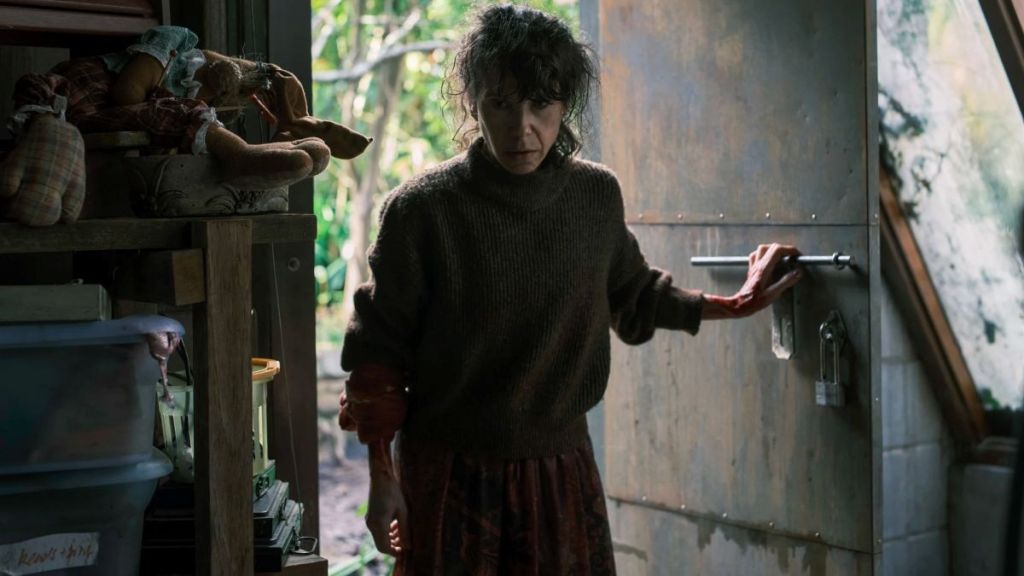
Where the film does succeed is in execution on a surface level. The gore is frequent and unapologetic, and the performances demonstrate clear competence and commitment. The actors deliver believable portrayals, and the film maintains tonal intensity throughout. However, strong performances and visceral imagery cannot substitute for a coherent narrative arc or structural integrity. These elements enhance a story; they do not replace it.
Looking At the Ratings a Little More Closely
In that context, the film’s elevated reception—particularly scores edging into the high sevens—feels difficult to reconcile. It is possible that, in a year perceived as comparatively sparse in high-intensity horror, the film’s strengths have been amplified by contrast. Yet when measured against other recent releases—”Sinners,” “Frankenstein,” “Final Destination 5,” “The Long Walk,” “Together,” among others—Bring Her Back falls short in narrative construction, technical balance, and overall cohesion.
Will Bring Her Back, Bring You Back
That said, interpretation is inherently subjective, and individual responses will always vary. Still, the gap between the film’s critical reception and its structural shortcomings invites a broader consideration: what does this discrepancy reveal about the current state of horror audiences—and the evolving standards by which excellence in the genre is now being measured?
 Uncut Diamonds