
Some films beckon critics by virtue of their positioning within awards season. Their acclaim alone becomes an invitation—an analyst’s cue to assess not only the individual work but also the broader temperature of the industry: what resonates, what falters, and what signals evolving tastes. That impulse informed my decision to engage with the 2025 feature film Bugonia. The result was both intriguing and, at moments, eyebrow-raising.
Bugonia
Directed by Yorgos Lanthimos and led by A-list talent including Emma Stone and Jesse Plemons, “Bugonia” centers on Teddy, a man convinced that a powerful executive named Michelle is an alien of Andromedan origin. Convinced that humanity hangs in the balance, Teddy enlists his cousin in a plan to kidnap Michelle and compel her to arrange a meeting with her supposed emperor. Michelle presents as a quintessential high-powered executive—precise, structured, and intense—making the collision between delusion and authority the film’s central axis. Predictably, Teddy’s erratic and poorly constructed plan unravels.
A Few Mechanics
At face value, the premise evokes the familiar “take me to your leader” trope. Alien paranoia is hardly uncharted territory, and the setup does not immediately distinguish itself as novel. The first half unfolds at a deliberately languid pace. Action is sparse; dialogue dominates. The narrative initially feels like an extended study of obsession—two men spiraling deeper into a belief system that may or may not have grounding. Sustaining engagement during this stretch proves challenging, as the plot appears to stall rather than escalate.
Holding Out: Weighing the Risk and Reward
Its awards-season placement, however, prompted persistence. The eventual payoff is measured rather than explosive. A discerning viewer may anticipate the narrative pivot well before its formal reveal. Although the screenplay introduces a red herring designed to redirect suspicion, the misdirection lacks sufficient force to override earlier narrative cues. We, for all practical purposes, believe that Michelle is not an alien, although she could very well present as one. We are later led to believe that she agrees to the pretense of throwing our protagonist off his guard. However, the astute observer understands what the most impactful resolution would mean and sees the misdirect for what it is, which essentially undercuts the purpose.
The film’s most affecting material resides in its final act—particularly the last fifteen minutes. Here, emotional clarity crystallizes. Teddy’s frantic intensity is contextualized, and Michelle’s composure gains dimension. The thematic core emerges, inviting viewers into a reflective space that operates almost like a mirror. The effect is potent, though arguably diluted by its delayed arrival. Concentrating on the emotional resonance so heavily at the conclusion risks undercutting its cumulative impact.
A Little Further Under the Hood

To the film’s credit, the groundwork provides Teddy with discernible internal logic. His methods are tethered to a personal rationale that prevents him from registering as purely irrational. This tethering to motive—however distorted—grounds the character enough to maintain narrative plausibility. Yet connective tissue between audience and character remains thin. Identification proves difficult. Performances might be described as deliberately restrained, even banal. Still, that tonal flatness aligns with characterization: a man consumed by fringe hypotheses and a being—whether alien or human—struggling within imposed constructs. The minimalism, while bordering on monotony, can also be read as disciplined commitment to tone. For some viewers, that precision will register as mastery; for others, as inertia.
Laying It on The Table
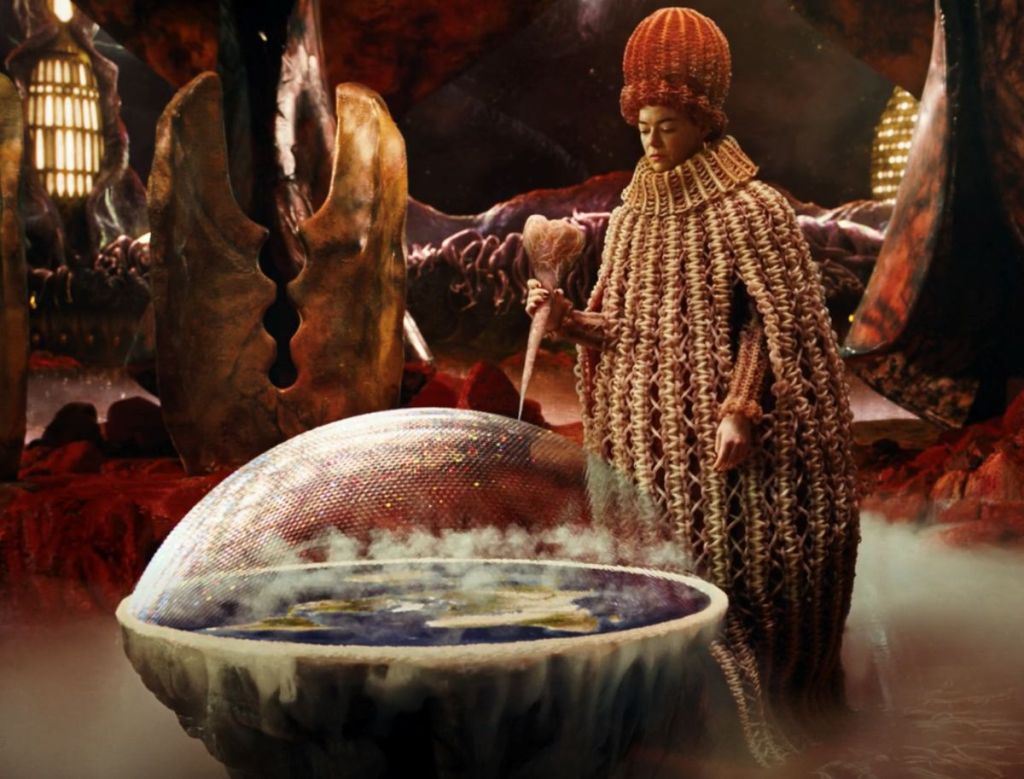
Ultimately, “Bugonia” is a film that withholds its thematic force until its closing movements. It resembles a multi-layered package—one that requires unwrapping several seemingly empty boxes before arriving at its emotional core. Is it seminal? In short, no. Its acclaim underscores a perennial truth: critical consensus is inherently subjective. This film stands as a clear illustration of that reality.
 Uncut Diamonds