
Stephen King created a masterpiece when he delivered the story of Carrie White. While he may not have known it at the time, he had crafted a timeless work that would become an enduring ode to the diabolical mistreatment of others through unrepentant bullying. The story has been revisited time and again, its relevance explored through generations of audiences who have watched its central tragedy unfold. Yet Mike Flanagan has come along and proven that when a story is handled with the right vision, there is always room for reinterpretation without stripping the original of its fervor and potency.
That is no small feat. There is a difference between revisiting a familiar property because it remains recognizable and finding something meaningful to say through it. The former can easily become an exercise in nostalgia, while the latter requires a creative understanding of what made the original resonate in the first place. Flanagan appears to understand that distinction, and his latest offering makes a compelling case for why some stories deserve another look.
Mike Flanagan, the “King Whisperer”
Mike Flanagan has slowly earned the moniker “The King Whisperer.” His handling of Stephen King’s work has not only served as a testament to the caliber of King’s writing but also to the depth of Flanagan’s vision and his ability to interpret the material in ways that are entertaining, emotionally resonant, and remarkably memorable.
Flanagan’s latest offering brings Carrie White to the small screen, giving the familiar horror heroine a more modern sensibility. Released in its entirety on Prime Video just weeks before Halloween, the eight-episode series arrives at a time when audiences are already looking for something wicked to get lost in. The timing could hardly be more appropriate. However, the calendar is not the only thing working in the series’ favor.
Across social media, particularly in horror-focused communities, viewers have been offering praise for the adaptation, with some already calling for more of the dark horror heroine, or monster, depending on one’s perspective. That distinction is worth considering. Carrie has always occupied an uncomfortable space between victim and avenger, a character whose suffering invites sympathy even as the consequences of her eventual unraveling become increasingly terrifying. The question has never been simply whether Carrie is frightening. It is how much of that fear belongs to her and how much belongs to the people who helped create the monster they claim to despise.
More Than Another Trip to the Prom
The series stars Summer Howell and Samantha Sloyan, with eight episodes averaging approximately 52 minutes each, according to IMDb. From the outset, Flanagan makes an interesting choice by introducing a glimpse of Carrie’s paternal figure, something that has received comparatively little attention in earlier screen adaptations.
Although brief, the addition contributes substantially to the foundation of Carrie’s story. Her father has long been a missing piece, a subject Margaret White has largely kept buried. Given her fanatical worldview, it is difficult to know how much truth lies beneath the things she eventually reveals to her daughter. That uncertainty adds another layer to a family dynamic already steeped in secrecy, control, and emotional deprivation.
Treatment of Testament
It is a small narrative decision with a larger purpose. Rather than treating Carrie’s circumstances as a collection of unfortunate events that eventually push a troubled girl over the edge, the series takes greater care to examine the forces that help shape her. The supernatural abilities may be what ultimately distinguish Carrie from those around her, but they are not the sole source of her tragedy.
This was an important element of King’s original novel, yet previous adaptations have not explored the material with the same degree of detail. Some of that difference can be attributed to the limitations of a feature film. There is only so much ground a movie can cover within its running time. A series, however, offers the opportunity to stretch out the narrative, develop its characters, and allow the audience to sit with the circumstances that bring them to their breaking points.
Still, additional time does not automatically translate into a better adaptation. More episodes can just as easily mean more unnecessary material. What matters is how that time is used. Flanagan’s approach demonstrates a strategic understanding of where the story can be expanded and how those additions can strengthen the narrative rather than distract from its central purpose.
The Cruelty Has Not Changed
One of the enduring strengths of Carrie is its understanding that the most disturbing horrors are not always supernatural. Sometimes they are standing right in front of us, laughing while someone else suffers, convincing themselves that cruelty is harmless because everyone else is doing it.
Flanagan preserves the sting of the mean-girl dynamic while bringing it into a modern era of cyberbullying, fake profiles, and calculated digital humiliation. The methods may have evolved, but the underlying impulse remains the same. People find ways to isolate those they consider different, exploit their vulnerabilities, and turn their pain into entertainment.
Carrie’s Swan Song

Carrie’s innocence and limited experience with the world leave her especially vulnerable to manipulation. Her exclusion from society has already placed her at a disadvantage, and those around her recognize that vulnerability as something they can exploit. The cruelty becomes more than a series of isolated acts. It becomes a sustained assault on a girl who has never been given the tools to understand the world she is expected to navigate.
This is where the story’s continued relevance becomes difficult to ignore. Technology has provided new ways to humiliate and ostracize people, but it has done little to change the mentality behind the behavior. The audience may be watching a fictional horror story, but the mechanisms driving its cruelty are painfully familiar.
There is something particularly unsettling about watching people participate in another person’s destruction while convincing themselves that it is nothing more than a joke. The horror of Carrie has always rested partly in that contradiction. The supernatural may deliver the reckoning, but human beings lay much of the groundwork long before the blood is spilled.
Margaret White: More Than a Villainous Caricature
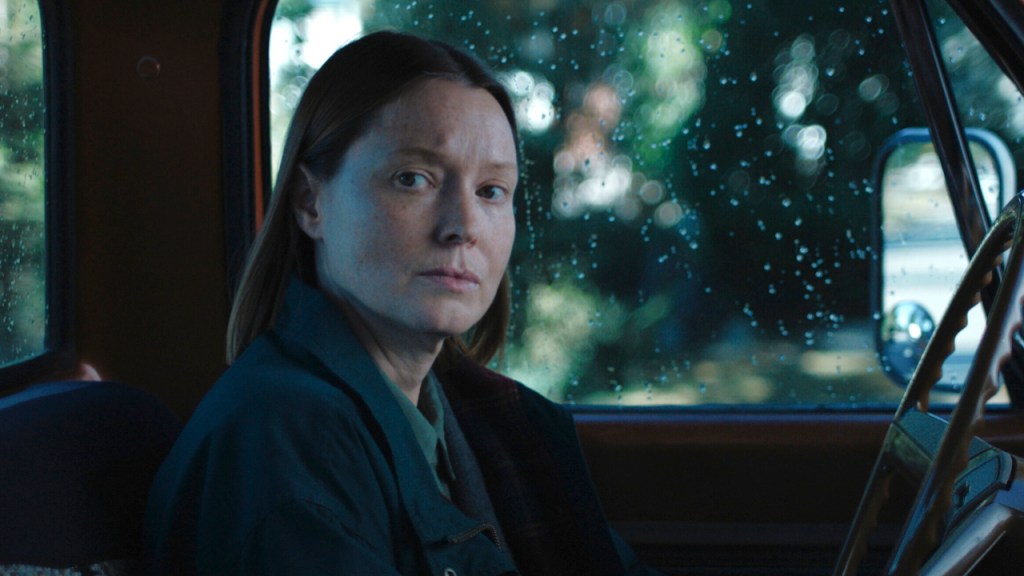
Flanagan’s attention to character development extends to Margaret White, whose fanaticism remains central to the suffocating environment in which Carrie is raised. Her beliefs are extreme, her behavior damaging, and her relationship with her daughter deeply troubling. Yet the series gives her a measure of nuance that makes her feel less like a villainous caricature and more like a flawed human being whose convictions have become destructive.
That distinction is important because adding nuance does not require excusing cruelty. Margaret’s actions remain harmful, but allowing greater insight into her character gives the narrative more credibility. She is no longer simply an unfeeling, soulless figure who sees her own daughter as a blot or stain. Instead, there is more room to consider the beliefs, fears, and distortions that inform her behavior.
The Depths of Fantacism
This does not make Margaret less disturbing. In some respects, it makes her more so. There is a particular kind of horror in watching someone cause harm while remaining convinced that they are doing what is right. When a person believes their convictions place them beyond question, accountability becomes nearly impossible, and those who suffer under their authority are left with little room to escape.
The added dimension strengthens the story’s through-line by making the conflict more than a battle between an innocent girl and a cruel world. It becomes an examination of how fear, isolation, control, and unchecked belief can shape a family and leave lasting damage. Flanagan does not need to make these characters entirely sympathetic to make them more human. He simply needs to make their choices, and the consequences of those choices feel credible.
The “King Whisperer” Knows When to Listen
Flanagan continues to solidify his standing as the “King Whisperer,” demonstrating that his understanding of Stephen King’s work extends beyond the ability to reproduce familiar imagery or revisit recognizable moments. His strength lies in recognizing what gives a story its staying power and finding ways to bring those elements into a new conversation with audiences.
There is always a risk in revisiting a property that has already been adapted multiple times. Familiarity can become a creative trap, encouraging filmmakers to lean on nostalgia rather than develop a fresh perspective. Audiences may appreciate seeing a beloved story again, but recognition alone is not enough to sustain its relevance. Eventually, a new adaptation has to justify its existence. Flanagan’s Carrie offers a reminder that the right vision can accomplish just that. By giving the characters more room to develop, exploring elements of Carrie’s background, and bringing the cruelty into a contemporary setting, the series finds opportunities to revisit familiar territory without abandoning the substance that made the original so powerful.
If nothing else, the relative success of this endeavor demonstrates that even a story told time and time again can find new life when the person handling it understands what should be preserved and what can be explored further.
Looking Further
Carrie White’s story has never been just about a girl with supernatural abilities or the destruction those abilities can unleash. It is about what happens when people repeatedly strip another human being of dignity, when humiliation becomes entertainment, and when cruelty is allowed to flourish without consequence. The supernatural may be what makes the story horror, but the human behavior at its center is what makes it endure.
That is the real achievement of a successful reinterpretation. It does not merely remind audiences why they loved or feared a story in the first place. It gives them another reason to think about it long after the credits roll. And in Flanagan’s hands, Carrie White still has plenty left to say.

