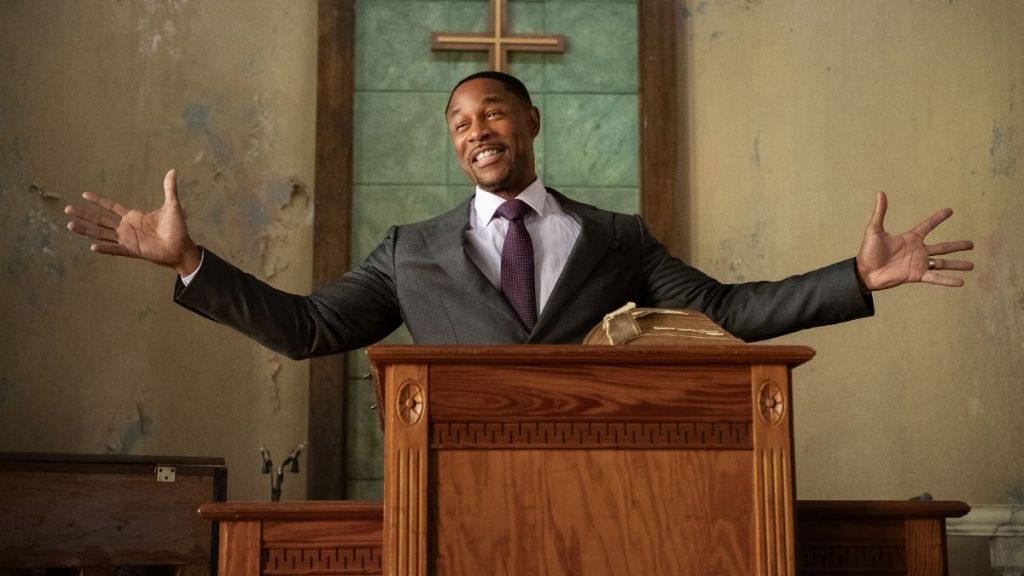
Tyler Perry’s newest film, a holiday offering entitled The Gospel of Christmas, is now streaming. With all the anticipation surrounding its release, one question remains: What is the final verdict?
Like many of Perry’s films, the jury is still sequestered. Those who have nurtured a connection to his work are offering high praise for the feature, while critics have plenty to say, and much of it is far from favorable.
A Different Kind of Holiday Offering
This is not Tyler Perry’s first venture into holiday filmmaking. Several years ago, Perry developed A Madea Christmas, a dramatic family affair with plenty of edge, as is often the case with features centered on Madea. It was the comedy, however, that gave that particular film its polish. The Gospel of Christmas is an entirely different ball game. This film is one hundred percent drama.
Perry has seemingly mastered the art of family conflict. It is one avenue in which he consistently excels. Yet this particular film ventures a little beyond his customary territory.
That is not to suggest Perry is unfamiliar with faith-based material or musicals. Theatrical productions steeped in gospel music were once his bread and butter. They provided the foundation upon which he built his career and powered his rise to prominence.
Even so, this type of production is not quite within the realm of what audiences have come to expect from Perry. His faith-based stage plays generally operate through three primary drivers: conflict, song, and a moral lesson. While those lessons often carry spiritual implications, they are not necessarily rooted in the theological subject this film’s title appears to suggest: the Gospel story, or what is commonly referred to as “The Good News,” which is delineated in the Biblical books of the Gospel, Matthew, Mark, Luke, and John.
Perry has frequently incorporated scripture into his theatrical productions. As some may recall, those biblical references often become punchlines, particularly when Madea flips the script, feigning familiarity with the Bible and the church while misquoting and misinterpreting scripture. One such example can be taken from a segment of dialogue written for Madea in the feature “Diary of a Mad Black Woman.” Madea’s line is written as thus, “Peace be still. That’s what he said. Peace be still. Well, you know what? Peace is always still around me, ’cause I keeps me what they call a piece of steel” referring to a weapon she keeps in her purse.
That approach generally gets a pass because the material is more parabolic in nature. Its purpose is to deliver a moral message, with comedy serving as the vehicle.
The Gospel in Name, but What of the Story?
The film is entitled The Gospel of Christmas, and its cast is heavily populated by gospel singers, along with performers whose musical careers straddle the boundaries between gospel and contemporary music. Naturally, one might expect the film to encompass the Gospel story, which, theologically speaking, addresses a very specific subject.
That is not quite what unfolds.
Instead, the implication is that the word “Gospel” refers less to the biblical account and more to the music that undergirds the narrative.
There is also the question of its seasonal identity. Although the film is presented as a holiday offering, surprisingly few scenes establish the Christmas setting. There are references to the family relocating during the season, and a Christmas tree provides a little visual grounding. Beyond those elements, however, there is very little that distinctly evokes the season.
The Core of The Gospel of Christmas
At the center of the story is a man who has seemingly gone astray. He comes from a family deeply rooted in the church and its operations. His lineage is not merely one of ministers but of pastors, men entrusted with overseeing congregations. Having departed to pursue his dreams and distance himself from his past, he eventually returns after failing to achieve the success he envisioned. His father has welcomed him home with open arms and entrusted him with what the family holds sacred an heirloom, including the responsibility of overseeing one of his very own father’s churches.
For anyone familiar with biblical teachings, the narrative framework is unmistakable. This is the story of the prodigal son. And Perry makes certain the audience understands that connection. The biblical parallel is repeatedly emphasized through the dialogue. This, ultimately, is the core of the film.
Biblical Symbolism and Familiar Cinematic Footprints
Perry attempts to further ground the narrative in biblical tradition by assigning many of the characters names associated with scripture. Interestingly, several of those figures are connected to biblical history predating the events central to the Gospel accounts.
There are also angels and other symbolic inclusions intended to create a spiritual atmosphere and lend a measure of theological substance to the proceedings. Yet these elements do little to disguise what is essentially the parable of the prodigal son dressed in holiday garb.
Those who are particularly fond of festive cinema may also recognize what appears to be inspiration drawn from other holiday features, including The Preacher’s Wife and Black Nativity. There is another film, released in 2005, entitled The Gospel, starring Boris Kodjoe, to which Perry’s offering bears an especially striking resemblance. The premise of that earlier production centers on a successful young R&B singer whose return home is prompted by the illness of his father, a bishop.
The similarities are difficult to overlook. Both narratives explore the return of a son who has distanced himself from his religious upbringing, the complicated relationship between father and son, and the enduring influence of the church upon a family’s identity. Both also rely upon gospel music to underscore the emotional and spiritual journey.
The parallels are so pronounced that Perry’s production occasionally feels less like an entirely new cinematic undertaking and more like a reworking of familiar material. Although the circumstances surrounding the respective homecomings differ, the narrative foundations share enough common ground to invite comparison.
What emerges is a hodgepodge of familiar cinematic and spiritual elements assembled in an attempt to invoke the spirit of the season, without offering much that feels particularly new.
When Musical Excellence Meets Dramatic Limitations
The film’s secret weapon is its singers. Unfortunately, their musical excellence does not compensate for the less accomplished acting.
Perry has built a reputation for assembling casts populated by performers capable of carrying his narratives. In many of his productions, those existing strengths help elevate the material, sometimes making it difficult to distinguish between the quality of the storytelling and the effectiveness of those bringing it to life. That is not necessarily the case here. The lead character, portrayed by musical artist Tank, struggles to convincingly inhabit the role.
His character is intended to appear detached from his roots, a man who severed those connections long ago and has returned carrying the emotional distance created by that separation. The difficulty is that the performance often feels contrived. Rather than allowing the character’s aloofness to emerge naturally, Tank appears to be consciously portraying someone aloof. There is a distinction.
The stiffness of the performance makes it challenging for the other actors to feed off his energy, diminishing the natural exchanges that might otherwise lend credibility to the family dynamics.
Fantasia Barrino, who occupies a supporting role, appears to wrestle with a similar difficulty. Barrino has previously demonstrated her theatrical abilities in The Color Purple, both onstage and in the film adaptation. Yet this production seems to amplify limitations that her earlier work did not bring so prominently into view.
There is no questioning Barrino’s extraordinary vocal talent. Acting, however, requires a different measure of expression, and in this particular production, her dramatic performance does not consistently reach the level of her musical abilities.
The deacon, a character positioned to provide a little levity amid the heaviness of the narrative, also falls short of the intended mark. His quips should offer moments of relief, yet the humor seldom lands with the necessary finesse.
Then there is the villain, the Devil.
His characterization is so conspicuously on the nose that it diminishes the dramatic stakes. There is little subtlety, leaving the audience with a representation that is more obvious than ominous. And when a story depends upon spiritual conflict, the absence of nuance can significantly weaken its impact.
The Voices That Give the Film Its Soul
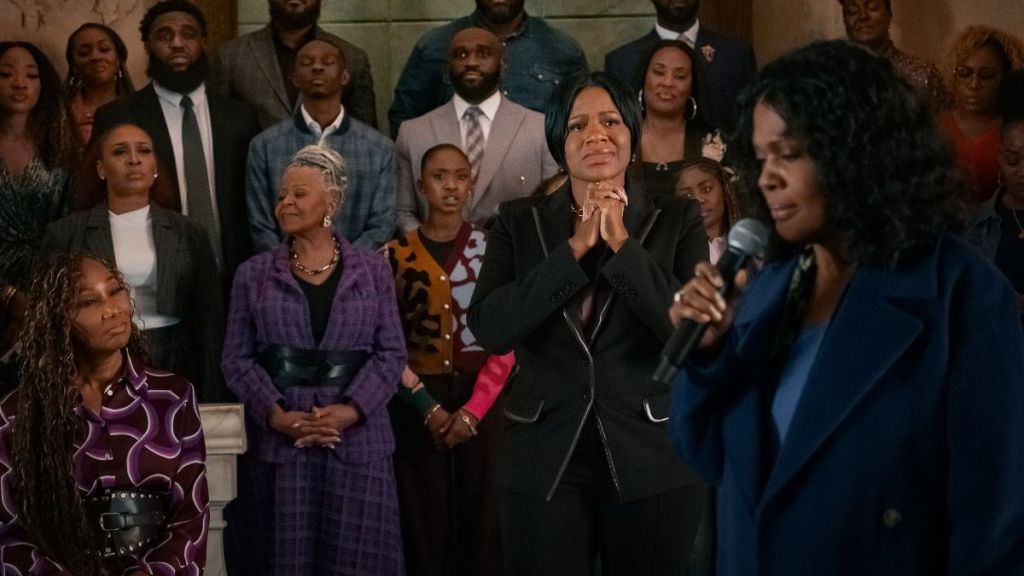
There is absolutely no doubting the musical gifts of Tank, Fantasia, Yolanda Adams, Hezekiah Walker, Shirley Ceaser, LeAndria Johnson, Ann Nesby, Fred Hammond, CeCe Winans, Chante Moore, and the other accomplished vocalists who lend their talents to this production. They perform with heart and soul. The tenor and timbre of their voices, coupled with the emotional conviction of their delivery, bring a depth that the dramatic performances struggle to achieve. Their music communicates messages of faith, struggle, restoration, and hope with remarkable power.
These performances are the film’s greatest asset and, arguably, its saving grace. Perry understands how to employ the strengths of one element to divert attention from the weaknesses of another. The music accomplishes that task admirably, even when the narrative surrounding it falters.
A Filmmaker With Stronger Works to His Credit
There are several Tyler Perry films of which I am a fan, works that I believe deserve recognition for what they accomplish. The Six Triple Eight, Straw, A Jazzman’s Blues, Acrimony, I Can Do Bad All By Myself, Temptation: Confessions of a Marriage Counselor, Daddy’s Little Girls, The Family That Preys, Good Deeds, For Colored Girls, A Fall from Grace, and Doing Life are among those I consider worthy of acknowledgment.
The Madea franchise, meanwhile, has carved out its own distinctive lane. Its continued success speaks to the connection Perry has established with an audience that understands and appreciates what those films are designed to deliver.
Unfortunately, The Gospel of Christmas does not stand among Perry’s more solid cinematic offerings. The film is rather messy, both in its narrative construction and its execution. It is also one of the few Perry productions I have encountered in which the casting feels particularly weak from a dramatic standpoint.
That is not to suggest the film is entirely without value. The parable of the prodigal son carries tremendous spiritual and moral significance. Its themes of repentance, reconciliation, forgiveness, and restoration remain resonant regardless of how many times the story is revisited. However, the value of the source material should not be confused with the quality of its cinematic interpretation.
The Final Verdict
Perry has demonstrated throughout his career that he is capable of delivering emotionally compelling stories, particularly when navigating the complexities of family relationships, personal conflict, and the consequences of human choices.
The Gospel of Christmas possesses a biblical foundation rich with possibilities, but the execution falls short of the promise. Its familiar narrative, uneven performances, and loosely constructed seasonal identity prevent it from becoming the distinctive holiday offering it might have been. There is inspiration to be found within the production, but inspiration alone is not the measure of cinematic excellence.
For those who have not yet seen The Gospel of Christmas and would prefer to arrive at their own conclusions, the film is currently streaming on Netflix.

