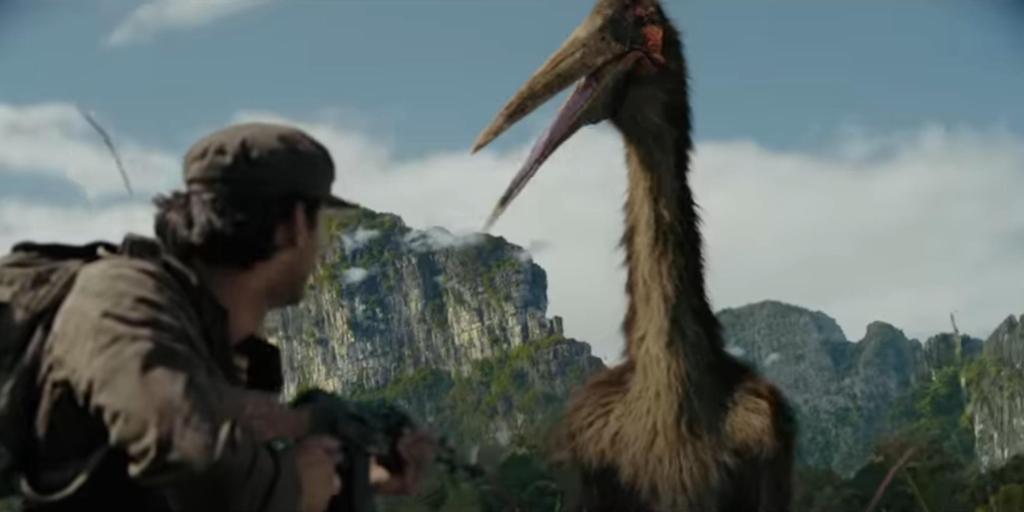
Ideas for film arise from countless spaces—both inside and outside the writer. Many filmmakers choose to hone in on issues with greater relevance to the current time and place to amplify resonance. The 2026 film Primitive War stands as such an example—proof that there is truly nothing new under the sun, but with every revolution of it, terrors wear new faces. Nevertheless, terror at its cellular level drives action despite the source. This film demonstrates that creatively blending current trepidations with historical ones makes quite an impression.
A Collision of Genres
Primitive War is a conflict-based science fiction horror thriller that combines three of cinema’s most potent elements: war, menacing prehistoric creatures, and technologically driven unknowns. The result plays like Platoon meets Jurassic Park, with a conspiracy-theory-based particle collider serving as the polarizing nucleus around which chaos orbits.
The Premise
The story is straightforward. A group of elite soldiers goes missing in the jungles of Vietnam. A special forces team known as the “Vultures” is dispatched on a rescue mission—only to discover that conditions on the ground are far more problematic than anticipated.
What they encounter defies belief yet remains entirely logical within the film’s internal rules. The journey ignites upon landing, and the visual execution proves effective—particularly the parallelism and contrast of dimension, scale, and savagery.
Layered Conflict and Intensity
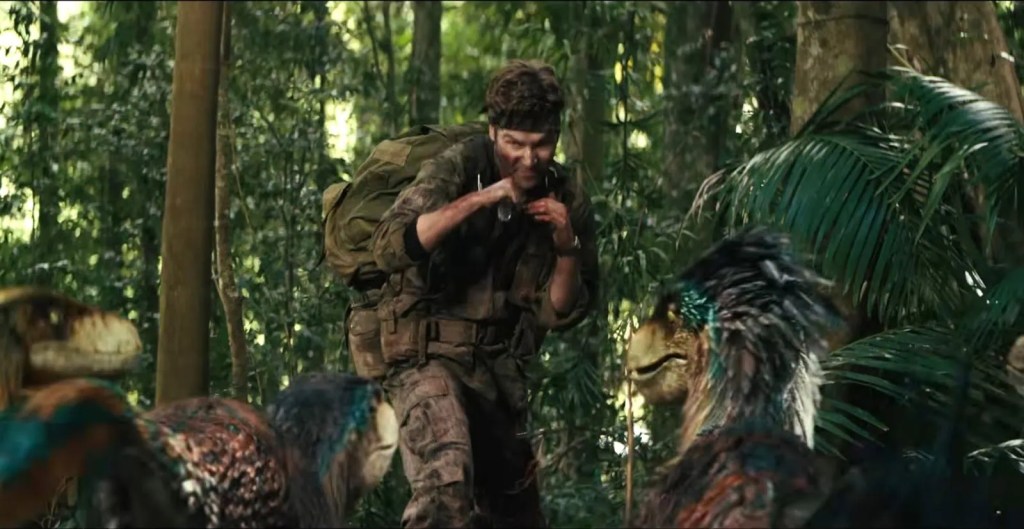
The film does not lack antagonistic forces. They are introduced progressively, raising stakes and driving both intensity and engagement. Given that the narrative depicts war on multiple levels—man versus man, man versus nature, and man versus self—there is ample emotional pull alongside the expected grotesqueries. As Culture Crypt notes,
“The film is absolutely stuffed to the gills with gunfire, frantic chatter, explosions, digital blood bursts, and of course, creatures. Constantly cluttered with noisy chaos, the screen is a nearly nonstop sensory assault of muzzle flashes, clinking bullet casings, and adrenaline-fueled macho men screaming through it all.”
Where It Falters
However, weaknesses emerge. The CGI rendering of the prehistoric beasts presents noticeable issues, particularly during direct confrontations with the soldiers. The seams show precisely when they should not. As Culture Crypt additionally notes,
“Entirely rendered via CGI, there are moments when “Primitive War’s” dinosaurs rival the realism of the first “Jurassic Park” film from 1993, thanks in no small part to how often their roaring rampages are partially obscured by darkness. Other moments, like when flying dinos attack in daylight, reveal the software’s sketchiness.”
Additionally, the theories surrounding particle colliders, timelines, and wormholes are complex subjects that may challenge some viewers. A baseline familiarity with these concepts helps underscore proof of concept, making the film more believable. Without that understanding, viewers may struggle to grasp the rules of the world or why the story exists at all—a critical barrier when asking audiences to invest in the narrative.
The Likability Problem
Perhaps the most significant flaw lies in finding a reason to root for the protagonists. Even the “good guys” prove difficult to like.
Characters do not need to be likable to be compelling. However, likable characters give audiences something to believe in—a reason to follow the narrative to its conclusion and something to discuss afterward. That connective tissue is largely absent here.
Lost in the Largeness
The actors are not the stars of this film; the story and creatures are. Unfortunately, the performers are overshadowed by the largeness of everything else. No one delivers a standout performance, and after the credits roll, they are quickly forgotten.
Final Verdict
Primitive War is interesting without being great and flawed without being awful. It offers something for viewers to think critically about while serving as an engine for imaginative speculation and expanded perspectives.
For that reason alone, it remains worth discussing.

