Franchise films are often experienced with significant gaps between installments, particularly by those who make a point of watching each release on opening night. That spacing creates a distinct analytical perspective, where each entry is judged with some narrative distance. In contrast, there are times when an analyst deliberately waits, choosing instead to view a franchise in one sitting. This approach offers a more cohesive understanding of character arcs, narrative momentum, and structural continuity. That was the perspective I brought to Greenland and its sequel. Both are enjoyable watches, though one proves more effective than the other.
Concept and Narrative Focus
“Greenland” initially seemed quite an oddly generic title for what is essentially a dramatic apocalyptic science fiction franchise built around planetary catastrophe. Currently consisting of two films, its premise is straightforward. Earth is being ravaged by a meteor event, and survival becomes the central concern. As is often the case, the narrative drills down to a core character through whom the story unfolds.
That character is John Garrity, played by Gerard Butler, a man with a particular skill set who must do whatever is necessary to save his family. The emotional core is established early when his wife and son are denied refuge in a secure “ark,” a controlled shelter designed to preserve select individuals.
The first film, running just under two hours, wastes little time. Within the first fifteen minutes, the pace accelerates into a sustained sequence of tension and movement. Butler delivers a strong performance that anchors the film and heightens engagement. However, the most significant weakness emerges in the form of plot armor. The central characters survive circumstances that strain credibility, a flaw that carries into the sequel.
Escalation in the Sequel
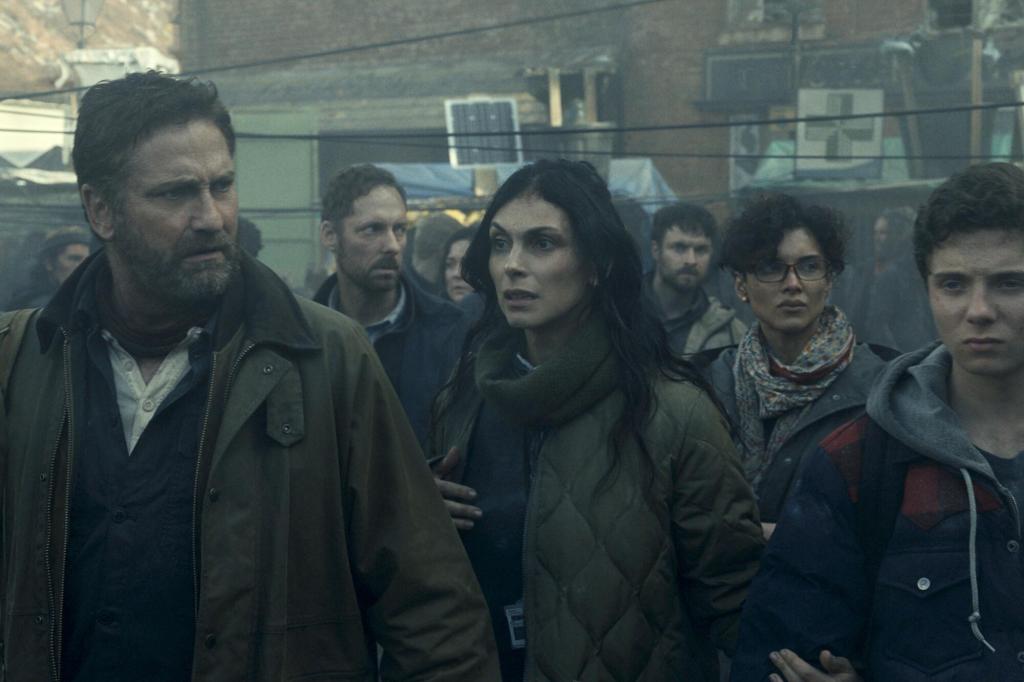
In the second film, the remnants of humanity continue to struggle for survival. The disaster is not fully resolved, and the world remains unstable, with infrastructure largely destroyed and the threat of further meteor activity still present. The Garrity family once again serves as the focal point, now navigating a landscape defined by scarcity and uncertainty.
What drives the narrative forward is the rumor of an oasis, a place where life may begin to flourish again. The possibility of finding the promised land and finding respite becomes the objective, giving the story direction and a measure of hope. As in the first film, the obstacles intensify as the journey progresses, maintaining a consistent level of engagement. Yet the issue of implausibility persists. The apparent invulnerability of the core group becomes increasingly difficult to accept, pulling the viewer out of the experience.
Resolution and Franchise Viability
The film concludes with a resolution that aligns with expectations. Given the binary nature of its stakes, the ending leans toward optimism. It provides closure in a way that suggests the narrative has reached its natural endpoint. There is a sense that the story has been fully told, and extending it further would risk diminishing its impact.
This is not a franchise that inherently required a sequel. Hollywood often capitalizes on initial success, and the reception of the first film clearly opened the door for continuation. However, the principle remains that the ability to extend a story does not always justify doing so. With each additional installment, the risk of narrative fatigue increases.
Final Assessment
Both films are ultimately watchable and entertaining, but the first is, however, superior, likely due to whatever novelty exists for the film. But of note, the premise is not the factor of originality here.
The stakes are undeniable, and the pacing ensures a consistently engaging experience. However, despite their strengths, they do not seem destined to leave a lasting cultural imprint. This is not a franchise that audiences are likely to revisit or discuss extensively in the years to come.
 Uncut Diamonds