Lena Waithe’s emotionally riveting and unflinchingly honest series The Chi has come to its close after an eight-year run. With a final season spanning ten episodes, the series worked to bring its many threads together with care, leaving behind a journey that invites reflection as much as it does appreciation.
A Story That Grew Beyond Its Origins
When The Chi premiered in the winter of 2018, Waithe introduced a story grounded in authenticity, one shaped by a desire to present a more truthful portrait of life in Chicago. That initial vision, while clearly defined, expanded over time into something more layered and far-reaching. As the narrative deepened, so too did its scope, evolving in ways that moved beyond its original framework.
Waithe has spoken openly about that evolution, noting how little control a creator ultimately has over what a story becomes.
“You could have a vision for your own life, but a higher power, the universe, has no patience for that vision. Because there’s another vision that you know nothing about, and you have no control over,” she said (The Hollywood Reporter).
That sense of surrender is reflected in the series itself, which grew with an organic rhythm that allowed its characters and themes to fully take shape.
A Season of Change and Reckoning
That growth is especially visible in the final season, where relationships are tested, redefined, and in many cases strengthened. The narrative leans into transformation, allowing its characters to confront the weight of their choices while moving toward something more stable and self-aware.
Though the series saw the departure of several characters over the years, its core remained intact. Those who stayed were given space to evolve, their arcs shaped by both hardship and resilience. What began in grit and pain gradually opened into moments of grace, even as the realities of violence and loss continued to cast a long shadow.
“Last Dance” and the Shape of Closure
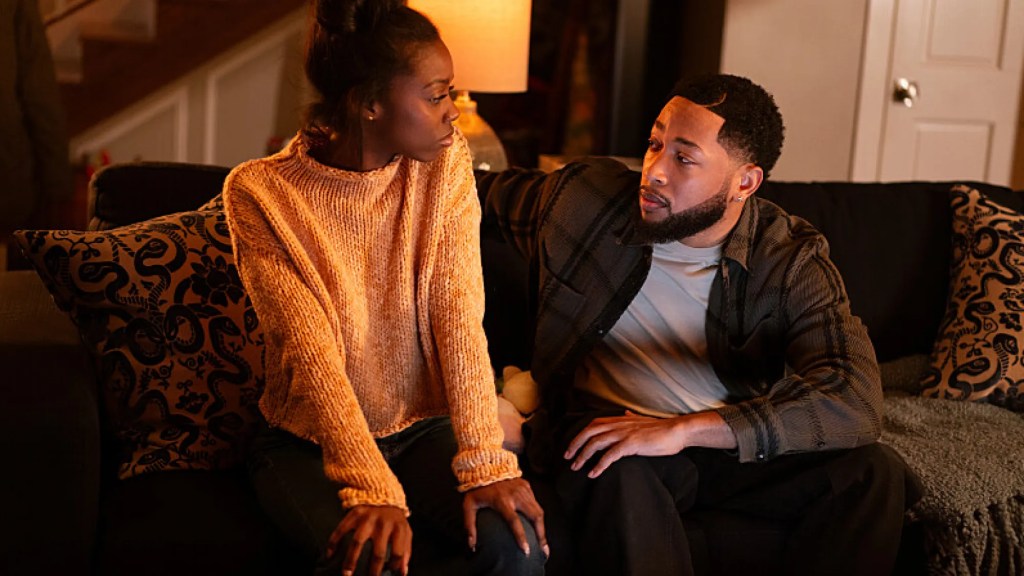
This progression carries seamlessly into the final episode, “Last Dance,” where viewers witness the long-anticipated wedding of Keisha and Emmett. Their union reflects a love shaped by struggle but sustained through growth and shared experience. It is not a conventional fairy tale, but one rooted in realism and perseverance.
Rather than ending on tragedy or ambiguity, The Chi closes with a sense of possibility. The resolution gestures toward hope and renewal, offering a quiet counterpoint to the instability and dissonance that often define both the series’ world and the broader cultural landscape. In doing so, it provides a form of closure that feels both intentional and necessary.
A Lasting Impact
That sense of intention extends beyond the narrative itself. As the series concludes, Waithe has reflected on its personal and creative significance, describing it as a defining force in her life.
“Everything that happened on the show was supposed to happen. And I’ve grown so much because of it. I’ve learned so much about who I want to be as a person, as an artist, as a leader, as a show creator and about what I want to say,” Waithe said.
With that reflection, the impact of The Chi becomes clear. Its reach extends beyond its storytelling, leaving behind a body of work that resonates not only for what it depicted but also for how it chose to evolve and ultimately conclude.

