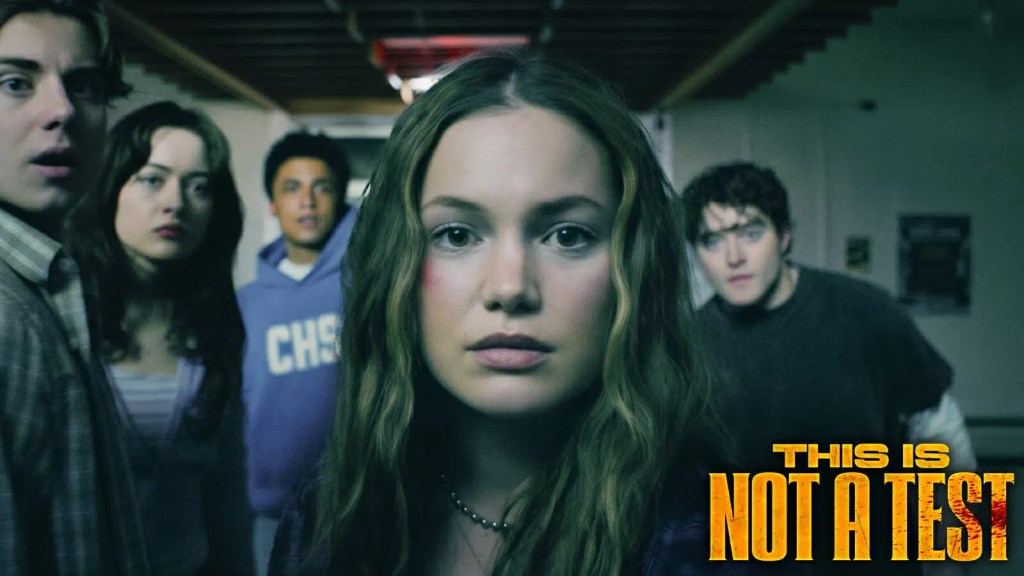
Because something can be attempted does not necessarily make it rational for it to be so. The 2026 feature This Is Not a Test challenges viewers to deliberate on one simple question: Is everything expedient? Does an outcome, or the cinematic device used to arrive there, automatically lend itself to a great story?
This Is Not a Test is an apocalyptic film with flesh-eating undead driving the plot forward. As the title suggests, survival is the objective. A small group of young adults find themselves in the thick of the rising carnage, with a school becoming the citadel where they gather to evade, and hopefully outlive, the horde.
The film establishes its relational dynamics early. There is a brother and sister who have lost their mother while trying to reach safety. A girl has lost her abusive father to the infected and has become separated from her sister. Another female subject and Two other teenage boys are thrown into the mix, rounding out the group and providing additional personalities for the survival experiment to test.
The Zombies Are Not Really the Test

While this film has zombies, it is again not really about zombies. It is about situational dynamics and the pressure points that determine whether people thrive or fail when confronted with extraordinary circumstances. These are challenges the characters have not prepared for, yet they must become resourceful enough to pass the test. Or fail it. And like many social experiments, this one does not end on the best note.
The problem is that the film itself becomes as predictable as a multiple-choice test where every answer is the same. There is little that distinguishes it. There are no standout features, extraordinary performances, particularly memorable cinematography, or narrative choices that elevate the material beyond what audiences have already seen.
Threat vs. Threat
The external threat remains relatively constant throughout. The real threat, as most viewers will likely recognize, is the toxicity brewing between the survivors. The internal conflict carries far more weight than the external one. That could work if the film were able to make that dramatic emphasis feel compelling. But this is a zombie film, and it becomes difficult to settle into the interpersonal drama while the more horrifying threat is steadily shrinking into the background.
When the Characters Become the Problem
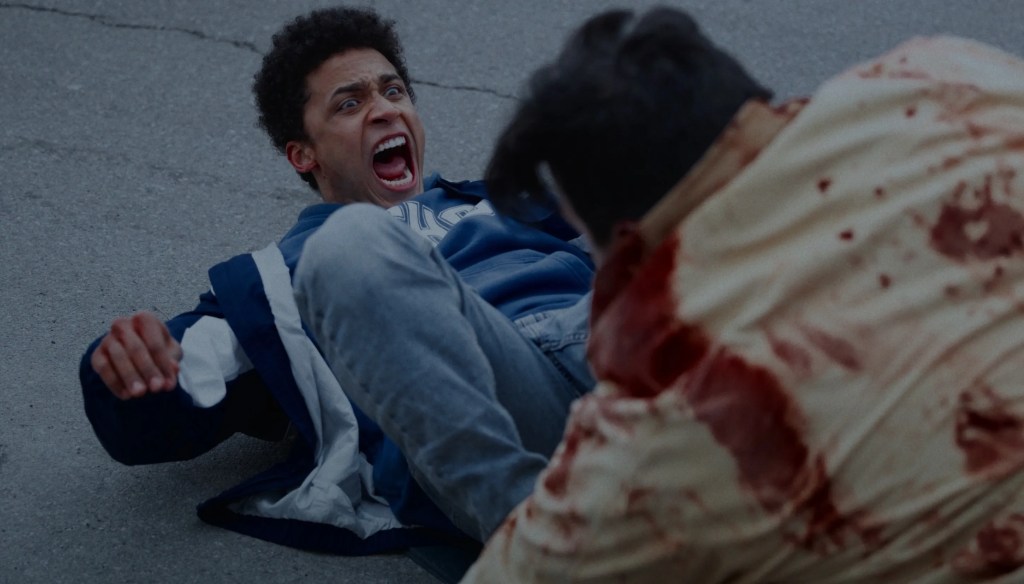
The story only works if the characters consistently act outside the norm. Unfortunately, the film relies on one illogical decision after another to move the story forward, taking characters out of the equation along the way.
By the end, no one has really learned anything. The only lesson the audience seems to receive is that some people are simply not the type of people you want beside you in a survival situation. In fact, taking your chances with the zombies might prove to be the more effective option if survival is truly the objective.
That becomes increasingly difficult to ignore as the story moves toward its conclusion. Not only is there no particularly credible climax, but the ending, in many ways, solidifies the question viewers may have been asking throughout the film: Why?
Of all things, the conclusion also leaves one major thread dangling. One character’s story arc is never properly closed. He simply disappears, leaving no real indication of whether he survived or did not.
This Test Did Not Make the Grade
This Is Not a Test did not make the grade. It plays like a film that existed for no other reason than to exist. Someone seemingly said, “Let’s make a zombie film with teenagers as the test group,” and then allowed the experiment to run its course. That is not necessarily a problem in itself. A simple premise can still become a compelling film when the characters, performances, storytelling, or larger message give it something more. Here, however, the pieces never quite come together in a way that makes the journey feel worthwhile.
The film is based on a pre-existing work written by Courtney Summers. Since I have not read the book, there is not much to be said on the translation of the work or the substance of the literary material. This is purely based on the viewing of the cinematic work.
As with most films I watch, I encourage viewers to make their own decisions. If the premise or logline interests you, invest the time and make your own determination. Art is purely subjective, and entertainment is defined vastly differently by every viewer.
From this side of the screen, however, This Is Not a Test was a big miss.
 Uncut Diamonds